

The Supreme Court ruled on Wednesday (September 30) in Sainaba v. State of Kerala & Anr. that a legal demand notice under the Negotiable Instruments Act, 1881, cannot be considered invalid merely because it was received by a family member of the cheque issuer. The notice was sent by registered post to the drawer’s correct address.
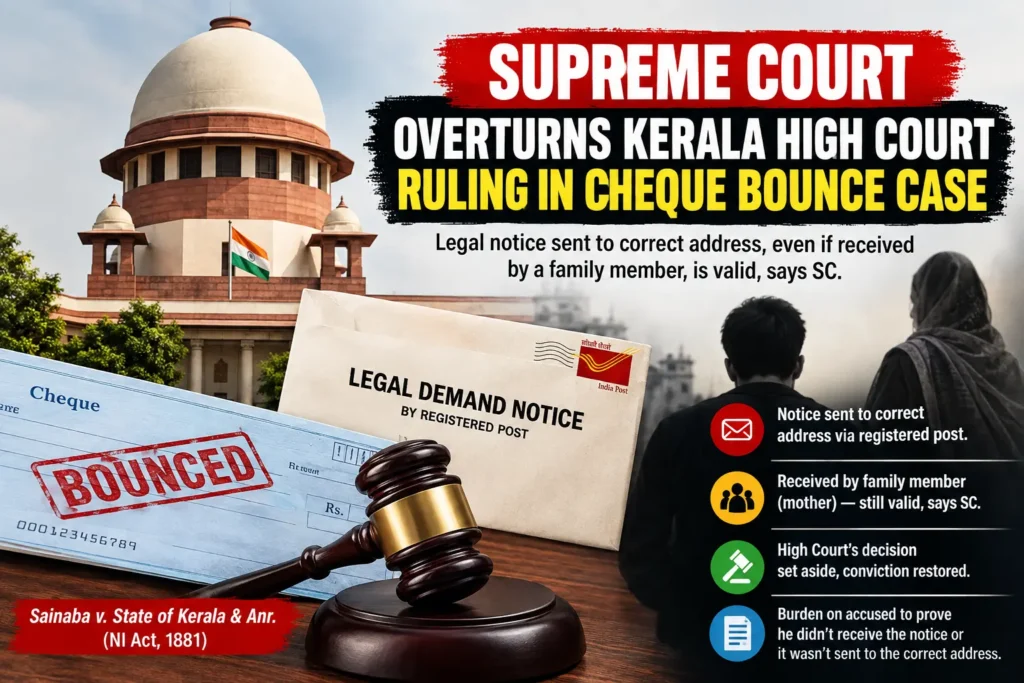
The Supreme Court has delivered a significant ruling on cheque bounce cases and legal demand notices. A bench comprising Justices Ahsanuddin Amanullah and Manmohan overturned a Kerala High Court judgment that had set aside the conviction of a cheque issuer. The High Court had based its decision on the fact that the legal demand notice was delivered to the issuer’s mother rather than directly to him, even though she lived at the address provided by the cheque issuer.
On Wednesday (September 30), the Supreme Court overturned the High Court’s decision, ruling that a legal demand notice under the Negotiable Instruments Act, 1881 (NI Act), cannot be declared invalid merely because it was received by a family member of the cheque issuer. The court stated that a conviction cannot be set aside on this ground alone, particularly when the notice was sent by registered post to the issuer’s correct address.
₹300,000 Loan Dispute: Supreme Court Case
According to a report by LiveLaw, the case Sainaba v. State of Kerala & Anr. involved a complaint under Section 138 of the Negotiable Instruments Act, 1881, concerning a ₹3 lakh loan given by the appellant to Respondent No. 2. The cheque issued by the respondent was dishonoured. Subsequently, on August 31, 2016, the complainant sent a legal demand notice by registered post to the respondent’s correct address. The notice was received by his mother, Amina. However, the respondent neither replied to the notice nor repaid the loan.
On July 10, 2019, the trial court convicted the respondent and sentenced him to six months of simple imprisonment along with a fine of ₹3 lakh. The appellate court upheld the conviction on February 16, 2023.However, the case took a significant turn when the Kerala High Court exercised its revisional jurisdiction under Section 397 of the Code of Criminal Procedure (CrPC) and overturned the conviction. The High Court held that the legal requirement under Section 138(b) of the NI Act had not been fulfilled because the demand notice had been received by the respondent’s mother rather than by the respondent personal.
Supreme Court Overturns Kerala High Court Ruling
Dissatisfied with the Kerala High Court’s decision, the complainant approached the Supreme Court. While allowing the appeal, the Supreme Court reiterated that once the statutory presumption of service applies, the complainant is not required to prove that the cheque issuer actually received the legal notice or deliberately refused to accept it.
According to the court, the complainant must send the notice to the cheque issuer’s correct address. Circumstances beyond the complainant’s control cannot, by themselves, invalidate the presumption that the notice was served.
The court observed that once a notice is sent to the correct address, the requirement of giving notice is fulfilled. The burden then shifts to the cheque issuer to rebut this presumption by proving that they had no knowledge of the notice, that it was not sent to the correct address, or that the postal endorsement was incorrect.

The Supreme Court found substantial evidence showing that the legal notice had been sent to the respondent’s correct address. The respondent subsequently appeared in court in response to a summons sent to the same address. The same address was also mentioned in his vakalatnama, appeal and revision petitions.
Furthermore, in his statement recorded under Section 313 of the CrPC, the respondent never disputed the accuracy of the address. There was also no evidence suggesting that he and his mother lived separately or had a relationship that would prevent him from learning about a notice received by her.
Considering these circumstances, the court concluded that the respondent had failed to rebut the presumption of service attached to the legal demand notice.Consequently, the Supreme Court allowed the appeal and restored the respondent’s conviction.